BOOK OF HEAVEN
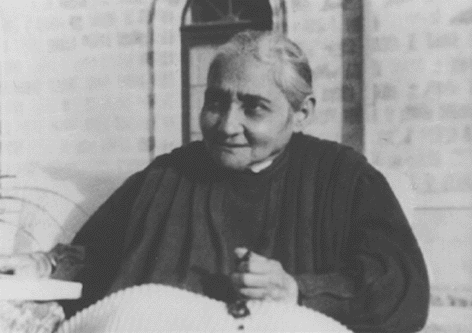
From the writings of the Servant of God, Luisa Piccarreta, The Little Daughter of the Divine Will
1/4/25 – Vol. 17
How all of Heaven goes to meet the soul who fuses herself in the Divine Will. How all want to place their acts in her, and the noble martyrdom of the soul is formed.
Having completed my whole day, I was thinking to myself: ‘What else is left for me to do?’ And in my interior, I heard: “You have to do the most important thing – your last act of fusing yourself in the Divine Will.”
So, according to my usual way, I started to fuse all my poor being in the Supreme Will; and as I was doing so, it seemed to me that the Heavens were opening, and I went to meet the whole Celestial Court, and all of Heaven came toward me. And my sweet Jesus told me: “My daughter (Luisa), fusing yourself in my Will is the most solemn act, the greatest one, the most important of all your life. To fuse yourself in my Will is to enter the sphere of Eternity, embrace It, kiss It, and receive the deposit of the goods which the Eternal Will contains. Even more, as the soul fuses herself in the Supreme Volition, all go to meet her, in order to communicate to her all the goods and the glory they have. The Angels, the Saints, the very Divinity – they all communicate, knowing that they communicate in that same Will in Which everything is safe. Even more, in receiving these goods, the soul multiplies them through her acts in the Divine Will, and gives back double glory and honor to the whole of Heaven. Therefore, by fusing yourself in my Will, you put Heaven and earth in motion. It is a new feast for the whole Heaven.
And since to fuse oneself in my Will is to love and to give, for each one and for all, without excluding anyone – in my Goodness, so as not to be won over in love by the creature, I place in her – in my Will – the goods of all, and all the possible goods I contain within Me. Nor can there be a lack of space in which to place all the goods, because my Will is immense, and is capable of receiving everything. If you(Luisa) knew what you (Luisa) do and what happens when you (Luisa) fuse yourself in my Will, you (Luisa) would eagerly yearn to do it continuously.
Afterwards, I was thinking about whether I had to write what is written above, or not. I didn’t see it as necessary, or as an important thing; more so, since obedience had given me no order to do it. And my sweet Jesus, moving in my interior, told me: “My daughter (Luisa), how can it not be important to make it known that fusing oneself in my Will is to live in It? The soul who fuses herself in my Will receives, as though in deposit, all my divine and eternal goods. The very Saints compete with each other in order to deposit their merits in the soul fused in my Will, because they feel in her the Glory, the Power of my Will, and feel glorified in a divine manner by the littleness of the creature.
Listen, my daughter: to live in my Will surpasses even martyrdom in merit. Martyrdom kills the body, but living in my Will implies that the creature kills her own will with a divine hand, and It gives her the nobility of a divine martyrdom. And every time the soul decides to live in my Will, my Volition prepares the blow in order to kill the human will, and forms the noble martyrdom of the soul. But in order to reach this happy state, the human will and the Divine Will must be tied together: one has to give the place to the Other, and the human will must be content with remaining extinguished under the power of the Divine Will. Therefore, every time you (Luisa) dispose yourself to live in my Volition, you (Luisa)dispose yourself to undergo the martyrdom of your will.
Do you (Luisa) see, then, what it means to fuse oneself in my Will? It is to be the continuous martyr of my Supreme Will. And you (Luisa) think it’s trivial, or not important?”
Permanent link to this article: https://luisapiccarreta.com/829-all-of-heaven-goes-to-meet-the-soul-who-fuses-herself-in-the-divine-will/
 Also known as
-
Aurelius Augustinus
-
Doctor of Grace
Profile
Son of a pagan father who converted on his death bed, and of Saint Monica, a devout Christian. Raised a Christian, he lost his faith in youth and led a wild life. Lived with a Carthaginian woman from the age of 15 through 30. Fathered a son whom he named Adeotadus, which means the gift of God. Taught rhetoric at Carthage and Milan, Italy. After investigating and experimenting with several philosophies, he became a Manichaean for several years; it taught of a great struggle between good and evil, and featured a lax moral code. A summation of his thinking at the time comes from his Confessions: “God, give me chastity and continence – but not just now.”
Augustine finally broke with the Manichaeans and was converted by the prayers of his mother and the help of Saint Ambrose of Milan, who baptized him. On the death of his mother he returned to Africa, sold his property, gave the proceeds to the poor, and founded a monastery. Monk. Priest. Preacher. Bishop of Hippo in 396. Founded religious communities. Fought Manichaeism, Donatism, Pelagianism and other heresies. Oversaw his church and his see during the fall of the Roman Empire to the Vandals. Doctor of the Church. His later thinking can also be summed up in a line from his writings: Our hearts were made for You, O Lord, and they are restless until they rest in you.
Born
Permanent link to this article: https://luisapiccarreta.com/828-feast-day-of-st-augustine-of-hippo/
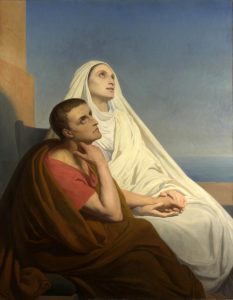
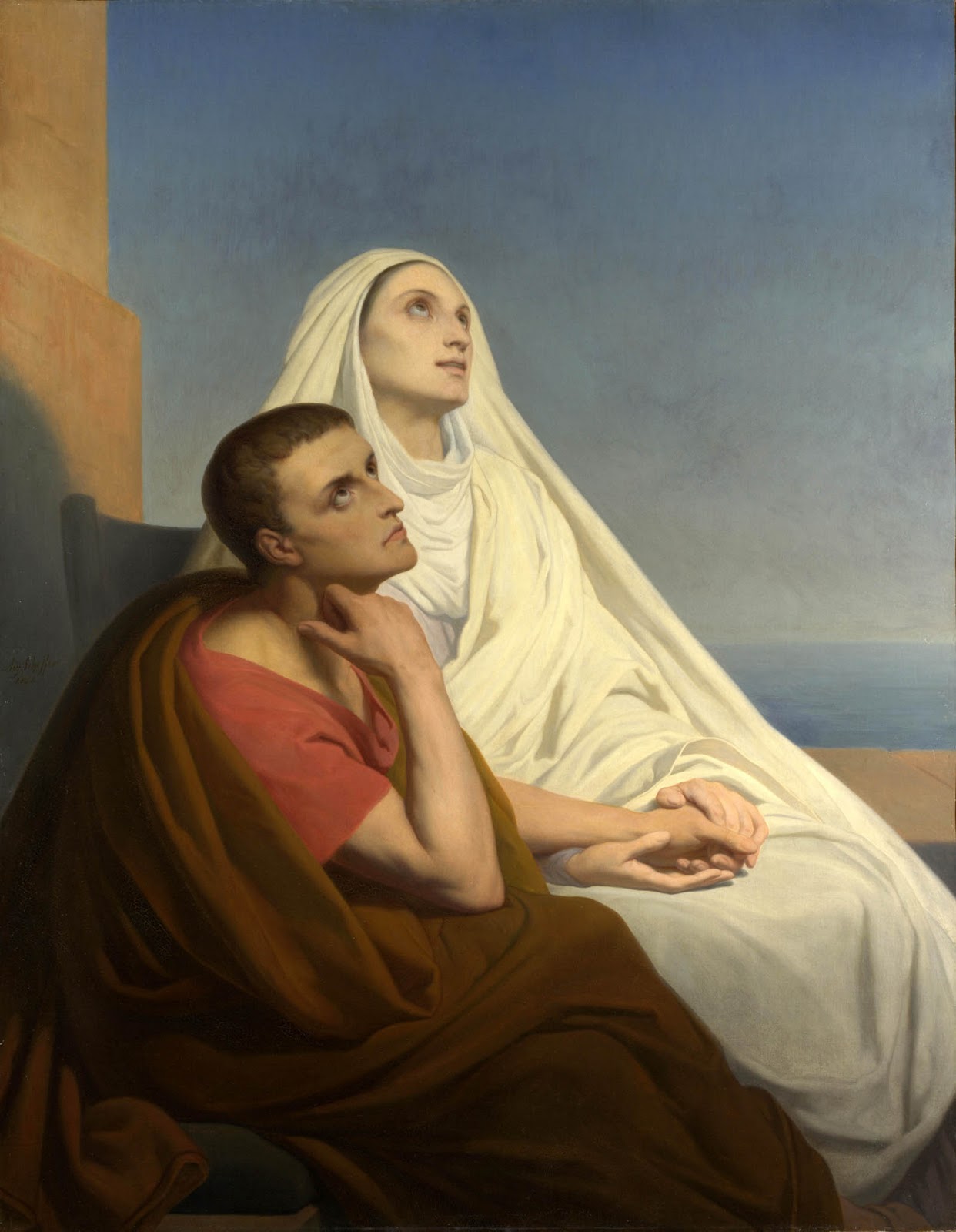
St. Augustine and St. Monica
Saint Monica, also known as Monica of Hippo, is St. Augustine of Hippo’s mother. She was born in 331 A.D. in Tagaste, which is present-day Algeria.
When she was very young, she was married off to the Roman pagan Patricius, who shared his mother’s violent temper. Patricius’ mother lived with the couple and the duo’s temper flares proved to be a constant challenge to young Monica.
While Monica’s prayers and Christian deeds bothered Patricius, he is said to have respected her beliefs.
Three children were born to Monica and Patricius: Augustine, Navigius, and Perpetua. Unfortunately, Monica was unable to baptize her children and when Augustine fell ill, Monica pleaded with Patricius to allow their son to be baptized.
Patricius allowed it, but when Augustine was healthy again, he withrew his permission.
For years Monica prayed for her husband and mother-in-law, until finally, one year before Patricius’ death, she successfully converted them.
As time passed, Perpetua and Navigius entered the religious life, but unfortunately Augustine became lazy and uncouth. This greatly worried Monica, so when Patricius died, she sent the 17-year-old Augustine to Carthage for schooling.
While in Carthage, Augustine became a Manichaean, which was a major religion that saw the world as light and darkness, and when one died, they were removed from the world of matter and returned to the world of light, which is where life comes from.
After Augustine got his education and returned home, he shared his views with Monica, who drove him from her table. Though it is not recorded how much time passed, Monica had a vision that convinced her to reconcile with her wayward son.
Monica went to a bishop, who told her, “the child of those tears shall never perish.”
Inspired, Monica followed Augustine to Rome, where she learned he had left for Milan. She continued her persual and eventually came upon St. Ambrose, who helped her convert Augustine to Christianity following his seventeen-year resistance.
Augustine later wrote a book called Confessions, in which he wrote of Monica’s habit of bringing “to certain oratories, erected in the memory of the saints, offerings of porridge, bread, water and wine.”
When Monica moved to Milan, a bishop named Ambrose told her wine “might be an occasion of gluttony for those who were already given to drink,” so she stopped preparing wine as offerings for the saints.
Augustine wrote: “In place of a basket filled with fruits of the earth, she had learned to bring to the oratories of the martyrs a heart full of purer petitions, and to give all that she could to the poor – so that the communion of the Lord’s body might be rightly celebrated in those places where, after the example of his passion, the martyrs had been sacrificed and crowned.”
After a period of six months, Augustine was baptized in the church of St. John the Baptist at Milan. The pair were led to believe they should spread the Word of God to Africa, but it the Roman city of Civitavecchia, Monica passed away.
Augustine recorded the words she imparted upon him when she realized death was near. “Son, nothing in this world now affords me delight. I do not know what there is now left for me to do or why I am still here, all my hopes in this world being now fulfilled.”
She was buried at Ostia, and her body was removed during the 6th century to a hidden crypt in the church of Santa Aurea in Osta, near the tomb of St. Aurea of Ostia.
In 1430, Pope Martin V ordered her relics to be brought to Rome and many miracles were reported to have occurred along the way. Later, Cardinal d’Estouteville built a church to honor St. Augustine called the Basilica di Sant’Agostino, where her relics were placed in a chapel to the left of the high altar.
Her funeral epitaph survived in ancient manuscripts and the stone it was originally written on was discovered in the church of Santa Aurea in 1945.
Douglas Boin translated the tablet’s Latin to read:
“Here the most virtuous mother of a young man set her ashes, a second light to your merits, Augustine.
As a priest, serving the heavenly laws of peace, you taught [or you teach] the people entrusted to you with your character. A glory greater than the praise of your accomplishments crowns you both – Mother of the Virtues, more fortunate because of her offspring.”
Permanent link to this article: https://luisapiccarreta.com/827-feast-day-of-saint-monica/
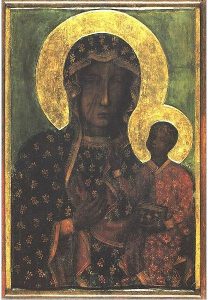
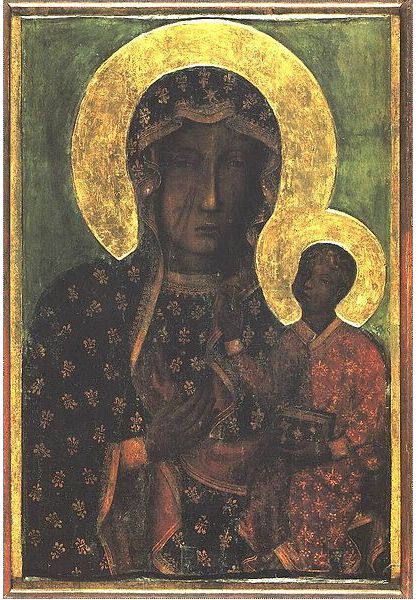
HISTORY OF THE IMAGE
The origin of this miraculous image in Czestochowa, Poland is unknown for absolute certainty, but according to tradition the painting was a portrait of Our Lady done by St. John sometime after the Crucifixion of Our Lord and remained in the Holy Land until discovered by St. Helena of the Cross in the fourth century. The painting was taken to Constaninople, where St. Helena’s son, the Emperor Constantine, erected a church for its enthronement. This image was revered by the people of the city.
During the siege by the Saracens, the invaders became frightened when the people carried the picture in a procession around the city; the infidels fled. Later, the image was threatened with burning by an evil emperor, who had a wife, Irene, who saved it and hid it from harm. The image was in that city for 500 years, until it became part of some dowries, eventually being taken to Russia to a region that later became Poland.
After the portrait became the possession of the Polish prince, St. Ladislaus in the 15th century, it was installed in his castle. Tartar invaders besieged the castle and an enemy arrow pierced Our Lady’s image, inflicting a scar. Interestingly, repeated attempts to fix the image, artistically have all failed.
Tradition says that St. Ladislaus determined to save the image from repeated invasions, so he went to his birthplace, Opala, stopping for rest in Czestochowa; the image was brought nearby to Jasna Gora [“bright hill”] and placed in a small wooden church named for the Assumption. The following morning, after the picture was carefully placed in the wagon, the horses refused to move. St. Ladislaus understood this to be a sign from Heaven that the image should stay in Czestochowa; thus he replaced the painting in the Church of the Assumption, August 26, 1382, a day still observed as the Feast Day of the painting. The Saint wished to have the holiest of men guard the painting, so he assigned the church and the monastery to the Pauline Fathers, who have devoutly protected the image for the last six hundred years.
Having survived two attacks upon it, Our Lady’s image was next imperiled by the Hussites, followers of the heretic priest, John Hus from Prague. The Hussites did not accept papal authority as coming from Christ and taught that mortal sin deprived an office holder of his position, among other heresies. Hus had been influenced by John Wyclif and became infected with his errors. Hus was tried and condemned at Constance in 1415. The Hussites successfully stormed the Pauline monastery in 1430, plundering the sanctuary. Among the items stolen was the image. After putting it in their wagon, the Hussites went a little ways but then the horses refused to go any further. Recalling the former incident that was so similar, the heretics threw the portrait down to the ground, which shattered the image into three pieces. One of the plunderers drew his sword and slashed the image twice, causing two deep gashes; while attempting a third gash, he was overcome with a writhing agony and died.
The two slashes on the cheek of the Blessed Virgin, together with the one on the throat, not readily visible in our copy, have always reappeared after artistic attempts to fix them. The portrait again faced danger in 1655 by a Swedish horde of 12,000, which confronted the 300 men guarding the image. The band of 300 routed the 12,000 and the following year, the Holy Virgin was acclaimed Queen of Poland.
In September 14, 1920, when the Russian army assembled at the River Vistula, in preparation for invading Warsaw, the Polish people prayed to Our Lady. the next day was the Feast of Our Lady of Sorrows. The Russians quickly withdrew after the image appeared in the clouds over Warsaw. In Polish history, this is known as the Miracle of Vistula.
During the Nazi occupation of Poland in World War II, Hitler order all religious pilgrimages stopped. In a demonstration of love for Our Lady and their confidence in her protection, a half million Poles went to the sanctuary in defiance of Hitler’s orders. Following the liberation of Poland in 1945, a million and a half people expressed their gratitude to the Madonna by praying before this miraculous image.
Twenty-eight years after the Russian’s first attempt at capturing the city, they successfully took control of Warsaw and the entire nation in 1948. That year more than 800,000 brave Poles made a pilgrimage to the sanctuary at Czestochowa on the Feast of the Assumption, one of the three Feast days of the image; the pilgrims had to pass by the Communist soldiers who patrolled the streets.
Today, the Polish people continue to honor their beloved portrait of the Madonna and Child, especially on August 26, the day reserved by St. Ladislaus. Because of the dark pigment on Our Lady’s face and hands, the image is affectionately called the “Black Madonna,” most beautifully prefigured in the Bible, in the Canticle of Canticles, “I am black but beautiful.” The pigmentation is ascribed primarily to age and the need to keep it hidden for long periods of time in places where the only light was from candles, which colored the painting with smoke.
The miracles attributed to Our Lady of Czestochowa are many and most spectacular. The original accounts of them, some of them cures, are archived by the Pauline Fathers at Jasna Gora.
Papal recognition of the miraculous image was made by Pope Clement XI in 1717. The crown given to the image was used in the first official coronation of the painting, which was stolen in 1909.
Pope Pius X replaced it with a gold one encrusted with jewels.
Miracles, Cures, and Signs
In 1430, Hussites (pre-Reformation reformers) attacked the monastery, slashed the Virgin’s face with a sword, and left it desecrated in a puddle of blood and mud.
It is said that when the monks pulled the icon from the mud, a miraculous fountain appeared, which they used to clean the painting. The icon was repainted in Krakow, but both the arrow mark and the gashes from the sword were left and remain clearly visible today.
In 1655, The miracle for which the Black Madonna of Czestochowa is most famous occurred, when Swedish troops were about to invade Czestochowa. A group of Polish soldiers prayed fervently before the icon for deliverance, and the enemy retreated.
On September 15, 1920, the Virgin again came to the aid of her people, when the Soviet Russian Red Army gathered on the banks of the Vistula River, preparing to attack Warsaw. The citizens and soldiers fervently prayed to Our Lady of Czestochowa and on the Feast of Our Lady of Sorrows, she appeared in the clouds above Warsaw. The Russians were defeated in a series of battles later dubbed the “Miracle at the Vistula.”
Permanent link to this article: https://luisapiccarreta.com/826-feast-of-our-lady-of-czestochowa/
BOOK OF HEAVEN
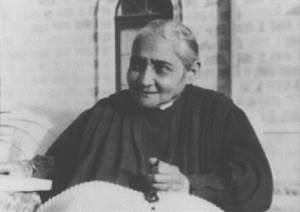
From the writings of the Servant of God, Luisa Piccarreta, The Little Daughter of the Divine Will
VOLUME 12
March, 18 1917
Effects of fusing oneself in Jesus.
I was praying, fusing all of myself in Jesus, and I wanted each thought of Jesus in my power in order to have life in each thought of creature, and to repair with the same thought of Jesus; and so with all the rest. And my sweet Jesus told me: “My daughter (Luisa), my Humanity on earth did nothing but connect each thought of creature with my own. So, each thought of creature was reflected in my mind, each word in my voice, each heartbeat in my heart, each action in my hands, each step in my feet, and so with all the rest. With this, I offered divine reparations to the Father. Now, all that I did upon earth, I continue in Heaven, and as the creatures think, their thoughts pour into my mind; as they look, I feel their glances in mine. Therefore, a continuous electricity flows between Me and them, just as the members are in continuous communication with the head. And I say to the Father: ‘My Father, I am not the only one who is praying, repairing, satisfying, appeasing You, but there are other creatures who do within Me whatever I do. Even more, with their suffering, they make up for my Humanity, which is glorious and incapable of suffering.’
By fusing herself in Me, the soul repeats all that I did, and continue to do. What will be the contentment of these souls who lived their lives in Me, embracing together with Me all creatures and all reparations, when they will be with Me in Heaven? They will continue their lives in Me; and as the creatures will think or will offend Me with their thoughts, these will be reflected in their minds, and they will continue the reparations which they did on earth. They will be, together with Me, the sentries of honor before the Divine Throne; and as creatures on earth will offend Me, they will do opposite acts in Heaven. They will guard my Throne; they will have the place of honor; they will be the ones who will comprehend Me the most – the most glorious. Their glory will be completely fused in Mine, and Mine in theirs.
Therefore, may your life on earth be completely fused in Mine. Do not do any act without making it pass into Me; and every time you (Luisa) will fuse yourself in Me, I will pour new graces and new light in you (Luisa), and I will become the vigilant sentry of your heart in order to keep any shadow of sin far away from you (Luisa). I will guard you(Luisa) as my own Humanity, and I will command the Angels to surround you (Luisa) like a crown, that you (Luisa) may be sheltered from everything and everyone.”
Permanent link to this article: https://luisapiccarreta.com/825-effects-of-fusing-oneself-in-jesus/