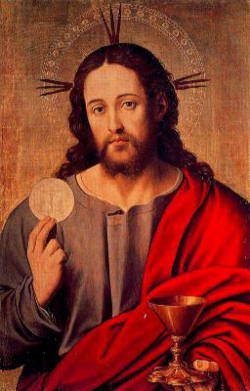
CORPUS CHRISTI PROCESSION IN A CONCENTRATION CAMP
Father Stephan Treuchel, S.A.C.
Introduction
“Corpus Christi Procession in a Concentration Camp” is a Testimony of the profound faith of imprisoned priests, written by a survivor of the Nazi persecution, Father Stefan Treuchel, S.A.C., member of the Polish Province of the Pallottine Fathers. It is presented here by his classmate, Father M. Ignatius Curzydlo, S.A.C., chaplain of the V.A. Medical Center, Canandaigua, New York.
We express our gratitude to the unnamed lay persons who have underwritten the costs of producing this article.
——————————————————————————————————————-
The thermometer was rising heavenward on the third day of June in 1942. We were 120 priests interned at Dachau and our chief occupation lay in the building of a so-called “Barrack X.” The handling of masonry was very exacting of our strength and the extreme heat took toll of all our energy. Moreover, we were starved and craving for water and the strict surveillance of our captors, who did not permit even the shortest respite was almost more than we could humanly bear.
Our only consolation lay in silent prayer and Holy Communion stealthily though seldomly received. Sometimes at noon, our Kapo[1], Karl Wagner and Hilfskapo[2] Gustav Eberle, former Communists who had fought with the Reds in the Spanish Civil War, and their helpers sought to escape the intense heat and retire into shade, and so we stopped working and instead our hearts were turned to the Throne of God in hearty prayer.
On this certain day in June, I stood beside Father Bronislaus Szymanski, (a fellow prisoner), who formerly served as a curate at a church in Suwalki[3]. We were pretending to be using our trowels and hammers vigorously, when in reality we were trying to deaden our low chanting of the Litany to the Sacred Heart of Jesus.
June the month of the Sacred Heart! How we wished to pay homage to this divine heart; yet, every means was denied us. We endeavored whenever possible, to recite the Litany to the Sacred Heart. This was done amid distraught distractions and many interruptions and it was sometimes after a long time that we were able to conclude, Sacred Heart of Jesus, delight of all the Saints, have mercy on us.
After the Litany on this memorable day, Father Bronislaus, after cautiously looking around whispered, “Father Stefan, will we be able to receive Holy Communion tomorrow?” “Why tomorrow?” I questioned. “Why especially tomorrow?”
“Because tomorrow is the Feast of Corpus Christi!”
Almost simultaneously with Father Bronislaus’s answer, Gustav came in view and with his unrefined and indelicate, “Auf, auf,” compelled us to return to work. I pretended to return for my tools for another word with Father Bronislaus, but for this I was brutally kicked and cursed at.
I hardly took notice of this for one incessant echo rant in my soul—tomorrow, Corpus Christi!
Dear God! Where will I obtain the Blessed Sacrament? True, not a distance from us were a group of German Priests, but we were entirely prohibited any conversation with them. Altar bread and wine—we had none!
But tomorrow—the feast of Corpus Christi!
No matter what I thought, every possibility to obtain the Blessed Eucharist for tomorrow morning seemed futile and yet how timely that we should receive It with great fervor—the feast of Its institution and the institution of the Priesthood. What to do? O Christ, Great Priest, we trust in Thee!
I had a restless night. The tension I was under reflected in my dreams and I was struggling with Gustav because he was about to tear away the Sacred Host from my hands when suddenly I awoke unrested to the “Auf, of” who was telling me that it was time to rise.
I washed and dressed hurriedly. After a very meagre breakfast I walked out to pray and tried to compensate in a small way for Holy Communion. I was surprised find almost immediately at my side, Father Joseph Fischer, a German Pallotine. He looked carefully around and handing me an envelope whispered, “Today is the feast of Corpus Christi and I brought you Holy Communion. Take care lest this be detected.” Could I ever describe my emotions? I scarcely had time for a whispered, “Thank you” when Father Fischer was gone and the shrill sound of a siren was summoning all of us. I took my place in line and pressed the Precious Envelope to my heart when from my soul burst out a prayer of Thanksgiving. But then, what should happen to me were my Treasure found? Would today be an inspection day? Where shall I place this envelope?
Suddenly an idea struck me! I took off my prisoner’s cap, tore a bit of lining, placed the envelope within and replaced my cap.
At the same time we had a roll call and after this we formed our lines to follow to our place of work. I hurriedly whispered to my companions and prisoner priests that I had the Blessed Sacrament with me so that each heart silently sang “Pange Linga Gloriosi.[4]” We were nearing the gate and I felt that my heart would almost break because it beat so rapidly since I was ever conscious of the Treasure I carried in so inappropriate manner. If only not to be suspected and not detected!
Soon we were told to remove our caps and I lovingly fondled my Blessed Lord. We were recounted and then began the very unusual and unforgettable Corpus Christi Procession. My head covered with a prisoner’s cap served as the monstrance; the ejaculations we whispered—the incense; the rhythmic beating of our shoes against the pavement—the bells; and the azure sky—the canopy! Can one imagine anything more beautiful in the life of a priest—a prisoner?
The happiness and contentment we felt at having with us the King of Kings was enough to make us almost immune to the loud commands of Gustav to sing what we sang almost to loathing, “Die blauen Dragonen sie reiten, mit klingendem Spiel durch das Tor, Fanfaren sie begleiten, hell zu dem Himmel empor.[5]” Yes, we sang, but the words had a very different meaning for us. We saw instead of the “blauen Dragonen” angel choirs accompanying us and their triumphant fanfare ascending into heaven.
Singing, some of us with our lips and some with our hearts, we finally came to the place of our work. We decided on groups and we agreed upon a place we were all to meet.
Normally, after a Corpus Christi Procession the Blessed Sacrament is reposed in the Tabernacle. Today, however, to our utter joy and happiness, our hearts were truly this Tabernacle.
Jesus Prisoner of Love, same to live in the hearts of His servants—prisoners in a Concentration Camp.
At the end of this Corpus Christi Procession on June 4, 1942, our hearts swelled out in the hymn of Praise and Thanksgiving, “TE DEUM LAUDAMUS[6]”
———————————————————————————————————————
PANGE LINGUA[7]
[1] Kapo—German for man in charge
[2] Hilfskapo—German for assistant man in charge
[3] City in Northern Poland
[4] Latin for “Sing my tongue the Savior’s glory”
[5] German for “The Blue Dragons ride with sonorous band through the gate, as the trumpets accompany them to the bright heaven above.”
[6] Latin for “We praise Thee O Lord”
[7] Latin for “Sing my tongue”—A Eucharistic hymn composed by St. Thomas Aquinas
Permanent link to this article: https://luisapiccarreta.com/96-corpus-christi-procession-in-a-concentration-camp/

Image: wikimedia commons.
Mother Teresa was a force of nature and wholly unique. She was always her own person, startlingly independent, obedient, yet challenging some preconceived notions and expectations. Her own life story includes many illustrations of her willingness to listen to and follow her own conscience, even when it seemed to contradict what was expected.
Permanent link to this article: https://luisapiccarreta.com/94-mother-teresa-a-holy-life/
XXIII Sunday in Ordinary Time
Evangelical consistency
9/2/2016 posted by luisapiccarretaofficial.org web site

Dear brothers and sisters, Fiat!
The Gospel of Luke, in the passage of Jesus’ journey toward Jerusalem, presents to us some messages that mean to descend into peoples’ heart. Jesus sees a lot of people who follow Him and therefore He turns back and explains what Christianity involves. Jesus is achieving a great fame and many people are attracted to Him but, as it often happens, the amount of people does not correspond to the quality and transparency of the life style. Jesus speaks openly and says that whoever does not carry his cross and follow Him cannot be His disciple.
Then He piles it on when He says to hate loves one because of the Gospel. The context makes us understand that to hate must not be interpreted in the sense of going against the fourth commandment, but it actually means “to love less than” or “to put behind”.
Jesus says that it is not easy to follow Him because you have put Him in first place always, so not even family links can impede God’s lordship over man.
Then Jesus mentions two parables taken from the Jewish context, but they refer to all times.
The first parable concerns a builder and the second a king, with a similar message: before starting any endeavour, you have to pause and reflect and to consider whether you are able to complete the work. The architect and the king accomplish this kind of effort, why doesn’t the Christian work in this perspective?
Jesus, at the end, reiterates the saying of being peoples capable of giving up all our possessions to gain eternal life.
Sometimes we take these passages lightly, or we say that they are too challenging.
But if we go down deep, we can see that we must grow and that it is important to make choices consistent with our belief. The radicality of the evangelical choice invites us not only to assert some ideas, but to accomplish them, even if we are aware of the cost of that choice. If we are called to choose between Jesus and money, pleasure or a career lived in such a way to destroy other people, we must undoubtedly choose Jesus. He invites us to meditate and consider if we want to become Christians or not , avoiding the risk of being tepid people or keeping a foot in both camps.
The Gospel seems to tell us to empty ourselves of all that is human, so that our will may rise up to Heaven and the Divine Will descend upon earth
Nothing enters into Heaven to live communal life with God, if it not completely divinized and transformed completely into Him; nor can His Divine Will descend upon earth and carry out Its Life as within Its own center if It does not find the human will emptied of everything, so as to fill it with all the goods which God’s Will contains.
So the human will be nothing other than a most thin veil, which will serve Him to cover Himself and to dwell inside of it, almost like a consecrated host, in which God forms His Life, He does all the good He wants, He prays, He suffers, He enjoys. And the host does not oppose – it leaves Him free; its office is to be there to keep Him hidden, and to comply in mute silence to preserve His Sacramental Life.
This is the point we are at: our will entering Heaven, and God’s Will descending upon earth. Therefore, our will must no longer have life – it must have no reason to exist.
The same happened to Jesus’ Humanity: though It had a human will, this will was all intent on giving life to the Divine Will. It never arbitrated itself, not even to breathe on its own, but its breath also it would take and give in the Divine Will. This is why the Eternal Will reigned in His Humanity on earth as It does in Heaven, It lived Its terrestrial Life in It, and Jesus’ human will, fully sacrificed to the Divine, impetrated that, at the appropriate time, the Divine would descend upon earth to live in the midst of creatures, just as It lives in Heaven.
Jesus entrusts Luisa an important task – to live in the midst of the Most Holy Trinity and to make all that is theirs hers own, and to give it to Them on behalf of her brothers; so that, drawn by what is Theirs, They may be bound to the human generations, and give them, once again, the supreme kiss of the union of their will with God’s Will, which He gave man in Creation.”
Today we have changed the order of values, so what is necessary has become superfluous; having, appearances and power have become the criteria of our life, and we have lost the sense of simplicity, of listening, of dialogue, of silence, of reflection.
We are full of things, but empty of meaning and hope. This is the greatest poverty that we are experiencing today. May the Lord grant us the strength to put into practice these teachings through clear choices to be lived in faith, even at the cost of paying personally.
Fiat!
Permanent link to this article: https://luisapiccarreta.com/94-evangelical-consistency/
BOOK OF HEAVEN
From the writings of the Servant of God, Luisa Piccarreta, The Little Daughter of the Divine Will
VOLUME 15
March 27, 1923
Sorrows of the Sacramental Life of Jesus. Graces and gifts with which He anticipates souls in order for them to receive Him.
After I received Communion, my sweet Jesus made Himself seen, and as soon as I saw Him, I threw myself at His feet, to kiss them and to cling to Him with all of myself. And Jesus, extending His hand to me, told me: “My daughter (Luisa), come into my arms, and even inside my Heart. I have covered Myself with the eucharistic veils so as not to strike fear. I have descended into the deepest abyss of humiliations in this Sacrament in order to raise the creature up to Me, identifying her with Me so much as to form one single thing with Me, and, by letting my Sacramental Blood flow inside her veins, constitute Myself life of her heartbeat, of her thought, and of her whole being. My love devoured Me and wanted to devour the creature in my flames, to make her be reborn as another Me. This is why I wanted to hide Myself under these eucharistic veils and, so hidden, enter into her to form this transformation of the creature into Myself. But in order for this transformation to take place, the dispositions were needed on the part of creatures; and my love, giving in to excess, in instituting the Sacrament of the Eucharist, released from within my Divinity more graces, gifts, favors and light for the good of man, to render him worthy to receive Me. I could say that it released so much good as to surpass the gifts of Creation. First, I wanted to give him the graces in order for him to receive Me, and then Myself, to give him the true fruit of my Sacramental Life.
However, in order to anticipate souls with these gifts, it takes a little emptying of themselves, hate of sin, and desire to receive Me. These gifts do not descend into rot, into mud. Therefore, without my gifts they do not have the true dispositions to receive Me, and in descending into them, I do not find the space to communicate my Life; I am as though dead for them, and they are dead for Me; I burn, and they do not feel my flames; I am light, and they remain more blinded. Alas! how many sorrows in my Sacramental Life. Many, feeling nothing good in receiving Me because of lack of dispositions, reach the point of nauseating Me; and if they continue to receive Me, it is to form my continuous Calvary and their eternal damnation. If it is not love that pushes them to receive Me, it is one more affront that they give Me – one more sin which they add to their souls. Therefore, pray and repair for the many abuses and sacrileges that are committed in receiving Me in the Sacrament.”
Permanent link to this article: https://luisapiccarreta.com/92-sorrows-of-the-sacramental-life-of-jesus/
From the writings of the Servant of God, Luisa Piccarreta, The Little Daughter of the Divine Will
V15–4.14.23
In this Seed and in this Hope that My Divine Will be done on earth as It is in Heaven, the very Saints have formed their Sanctity, and the Martyrs have shed their blood. There is no Good which does not Derive from this Seed. So, the whole Church Prays; and just as the tears, the penances, the prayers to obtain the Messiah were directed toward that Excelling Virgin Whom I was to Dispose in order to Centralize such a great Good in Her, so that they might Receive their Savior, even though they did not know Whom She would be – in the same way, now, when the Church Recites the ‘Our Father’, it is precisely for you (Luisa) that She Prays, so that I may Centralize in you all the Good that My Divine Will contains, the ‘Way’ – the ‘How’ the Divine Will may have Life on earth as It does in Heaven. And even though you are not Known, by Echoing My Prayer, ‘Thy Will be done on earth as It is in Heaven’, the Church Prays Me, presses Me to Centralize all this Good in a second virgin, so that, like a Second savior, she may save unsafe humanity; and making use of my inseparable Love and Mercy, I may answer My Own Prayer, United to that of the whole Church, making man come back to his Origin, to the Purpose for which I Created him – that My Divine Will be done on earth as It is in Heaven. This is precisely the Living in My Divine Will; and everything I keep Manifesting to you (Luisa) pushes you (Luisa) to this, confirms you (Luisa) in this. This is the great Foundation I keep Forming in your soul; and in order to do this, I keep Centralizing in you (Luisa) all the Graces, past, present and future, which I have given to all generations. Even more, I Double them, I Multiply them, because since My Divine Will is the Greatest, the Holiest, the Noblest Thing, which has no Beginning and no End, in order to Place It in one creature, it is Right and Decorous that I Centralize in her all possible Goods, Innumerable Graces, Divine Purity and Nobility, so that this Will of Mine may have the same Cortege It has in Heaven. It is the same Will that Operated in Redemption, and wanted to make use of a Virgin. What Portents and Prodigies of Graces did It not work in Her? My Divine Will is Great, It contains all Goods, and in Operating, It Acts with Magnanimity; and if it is about doing Works and doing Good for all humanity, then It puts all of Its Goods at stake.
Permanent link to this article: https://luisapiccarreta.com/831-the-our-father-and-luisa/