Permanent link to this article: https://luisapiccarreta.com/1229-the-will-of-the-soul-as-present-for-baby-jesus/
Dec 27
12/28 On this day in 1938 the Servant of God Luisa Piccarreta writes the last chapter of Volume 36. The obedience to write ceases.
Every day the Servant of God Luisa Piccarreta attended Holy Mass celebrated in her room, receiving the Most Holy Eucharist daily. She urged everyone to go to Mass on Sunday, and one time rebuked my sister Maria because she had not gone there. This said, it is unthinkable to attribute to the Servant of God behaviors that are not conformed to the Magisterium and to the Precepts of Holy Mother Church.
In order to understand well the spirituality of the Servant of God, the following requirements are necessary:
-
The groups must be formed by Eucharistic souls;
-
The groups must be devoted to the Most Holy Virgin, Mother of God;
-
They must be submitted, in everything, to the authority of the Church and especially to their own Bishop, who is the only guarantee of the Faith in the local Church;
-
All the writings that make reference to the diaries of Piccarreta, must be read and interpreted, only and solely, in the light of Sacred Scripture and of the Magisterium of the Church.
The groups must have as spiritual father, priests of sure orthodoxy, and who are legitimately incardinated in their own dioceses or, if religious, in the order they belong to.
The groups must gradually form and watch out for inappropriate fanaticism or inappropriate interpretations. Watching out for these inappropriate interpretations they should certainly avoid attitudes that border on heresy.
Our duty is exactly this: a correct interpretation of the writings of Piccarreta in the light of the Magisterium of the Church; this is the precise will of this soul all of God, and very faithful and very obedient daughter of the Church.
One who acts otherwise, is certainly a diabolical being who wants to hinder the fulfillment of the Kingdom of the Divine Will, of which the Servant of God is the bearer.
FIAT
Fr. Bernardino Bucci
Permanent link to this article: https://luisapiccarreta.com/1228-on-this-day-in-1938-the-servant-of-god-luisa-piccarreta-writes-the-last-chapter-of-volume-36-the-obedience-to-write-ceases/
Dec 27
12/28 Feast of the holy Innocents, Martyrs
December 28th, A.D. 2016 – Holy Innocents, Martyrs
Calendar for the Traditional Roman Rite
In the second chapter of the Book of Matthew is recorded the story of the Massacre of the Holy Innocents, an event which recalls the Pharaoh’s instructions to midwives during the time Israel was enslaved in Egypt:
Exodus 1:15-16, 22:
And the king of Egypt spoke to the midwives of the Hebrews: of whom one was called Sephora, the other Phua, Commanding them: When you shall do the office of midwives to the Hebrew women, and the time of delivery is come: if it be a man child, kill it: if a woman, keep it alive…
…Pharao therefore charged all his people, saying: Whatsoever shall be born of the male sex, ye shall cast into the river:
whatsoever of the female, ye shall save alive. Moses was saved from this murder when his mother placed him in a little ark and floated him in the river. Moses’s sister watched from afar as the Pharaoh’s daughter found the child (Exodus 2).
The massacre from which Moses was spared is a type, a foreshadowing, of the massacre of the holy innocents that took place soon after Christ was born.
As to the slaughter of the Innocents in the New Testament, first some background: Herod the Great, the Governor of Galilee, was an Idumean Jew whom History describes as an extremely cruel man: he was a man who killed several of his wives and his own sons when he suspected they were plotting against him. Challenges to his power were met with a swift and final response, and he even tried to ensure that his cruel campaigns survived him when he arranged that on the day he went on to his eternal reward, hundreds of men in the area would be killed so that there would be mourning at his funeral.
Though this arrangement was never carried out, it speaks well of Herod’s nature. And during this tyrant’s reign, the Magi — whose adoration of Baby Jesus is remembered on the Epiphany (6 January) and its Eve (Twelfthnight) — saw the Star of Bethlehem and went to Jerusalem, asking where the new King of Jews may be found. Herod heard of their asking around about the newborn King and, calling the high priests to find out about this this Child, was informed that it was prophecied that the Child would be born in Juda. Threatened by this prophecy, he sent for the Magi to find the Child and report back so he could go and “worship,” too.
The Magi found Jesus but, knowing Herod’s heart after having it revealed to them in a dream, didn’t go back to tell Herod of His wherabouts. Meanwhile, the Holy Family, warned through St. Joseph who was visted by an angel in a dream, makes their flight into Egypt. Herod became enraged at the Wise Men’s “betrayal,” and killed all the baby boys in Bethlehem who were two years old and younger.
The fourth day of Christmas commemorates these baby boys, who are considered martyrs — the very first martyrs (St. Stephen, whose Feast was commemorated 2 days ago, was the first martyr of the Church Age). As Bethlehem was a small town, the number of these Holy Innocents was probably no more than 25, but they are glorious martyrs who died not only for Christ, but in His place. Vestments will be red or purple in mourning, and the Alleluia and Gloria will be supressed at Mass.
Permanent link to this article: https://luisapiccarreta.com/1228-feast-of-the-holy-innocents-martyrs/
Dec 26
12/27 FEAST DAY OF ST. JOHN
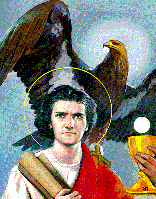
12/27 Feast Day of St. John
St. John, Apostle and Evangelist
To St. John we owe a Gosple, three Epistles and the Apocalypse, with the most beautiful pages on the Divinity of the Word made flesh; for this reason he is symbolized by the eagle which soars in the heights. On the Cross Our Lord Jesus Christ entrusted His Most Holy Mother Mary to St. John: “Woman, behold thy son.”
St. John only escaped a violent death by the special protection of God, and which made many believe that the beloved disciple would not die. Actually he did not depart this life until all the other apostles had passed away.
The following selections are from the EWTN website on St. John the Apostle and Evangelist (click here to view it in its entirety):
The great love which St. John bore to his God and Redeemer, and which he kindled from his Master’s Divine breast, inspired him with the most vehement and generous charity for his neighbor. Without the sovereign love of God no one can please Him. “He that loveth not, knoweth not God, for God is charity.” [I John 4: 8] “Let us therefore love God, because God first hath loved us.” [I John 4: 19] This is the first maxim in a spiritual life, which this apostle most tenderly inculcates. The second is that our fidelity in shunning all sin, and in keeping all God’s commandments, is the proof of our love for God, [I John 3, 4, etc.] but especially a sincere love for our neighbour is its great test. “For he that loveth not his brother whom he seeth, how can he love God whom he seeth not?” says St. John. [I John 4: 20]
St. John teaches us that to attain to this heavenly and Christian disposition, to this twofold charity towards God and towards our neighbour for His sake, we must subdue our passions and die to the inordinate love of the world and ourselves. St. John’s hatred and contempt of the world was equal to his love of God, and he cries out to us, “My little children, love not the world, nor the things which are in the world. If anyone loves the world the charity of the Father is not in him.”
BOOK OF HEAVEN
From the Writings of the Servant of God, Luisa Piccarreta,
the Little Daughter of the Divine Will
Volume 4
December 4, 1902
Jesus manifests the reasons of His operating.
I was thinking in my mind about this obedience, saying: ‘They are right in commanding me this way; besides, it is not such a great thing that the Lord would allow me to obey in the way wanted by them. So they say: either He should let you obey, or He should tell the reason why He wants the confessor to come to make you come round from that state.’ While I was thinking of this, my adorable Jesus moved in my interior, telling me: “My daughter, I wanted them to find the reason of my operating by themselves, because in my life, from the moment I was born up to my death, everything can be found, since the life of the whole Church is enclosed in it. When compared to some step that can be conformed to my life, the most difficult matters are solved, the most tangled situations are unraveled, and in the most obscure and abstruse ones, such that the human mind almost becomes lost in that obscurity, one finds the clearest and brightest light. This means that they do not have my life as the rule of their operating, otherwise they would have found the reason. But since they have not found the reason themselves, it is necessary that I speak and manifest it.”
After this, He stood up and with empire – but so much that I became fearful – He said: “What is the meaning of that ‘ostende te sacerdoti’ [‘show yourself to the priest’]?” Then, becoming sweeter, He added: “My power extended everywhere, and from any place I was I could operate the most sensational miracles; yet, in almost all my miracles I wanted to be personally present. As for example, when I resurrected Lazarus, I went there, I had them remove the sepulchral stone, then I had him released, and then, with the empire of my voice I called him back to life. In resurrecting the young girl, I took her by the hand with my right hand, and I called her back to life; and in many other things which are recorded in the Gospel, and which are known to all, I wanted to be there with my presence. This teaches the way in which the priest must behave in his operating, since the future life of the Church was enclosed in mine. And these are things that pertain to you, though in general; but your specific circumstance they will find on Calvary. I, priest and victim, lifted up on the wood of the cross, wanted a priest to be present, to assist Me in that state of victim – and he was Saint John, who represented the nascent Church. In him I saw everyone – Popes, bishops, priests and all the faithful together; and while assisting Me, He offered Me as victim for the glory of the Father and for the good outgrowth of the nascent Church. The fact that a priest assisted Me in that state of victim did not happen by chance, but everything was a profound mystery predisposed ab aeterno [from eternity] in the divine mind, intending that when I choose a soul as victim for the grave needs present in the Church, a priest must offer her to Me, assist her for Me, help her and encourage her to suffer. If these things are understood – fine, they themselves will receive the fruit of the work they offer; just like Saint John: how many goods did he not receive for having assisted Me on Mount Calvary? If then they are not understood, they do nothing but put my work amid continuous contrasts, diverting my most beautiful designs.
In addition to this, my Wisdom is infinite, and when It sends some cross to a soul for her sanctification, It does not take that soul alone, but five, ten… as many as I please, so that not one alone, but all others together may be sanctified. In fact, on Calvary I was not alone; in addition to having a priest, I had a Mother, I had friends and also enemies, and on seeing the prodigy of my patience, many of them believed in Me as the God I was, and were converted. Had I been alone, would they have received these great goods? Certainly not.”
But who can say everything He told me, or explain the most minute meanings? I said this the best I could – the way I was able to say it in my roughness. I hope that the Lord will do the rest, by illuminating them so that they may comprehend what I have not been able to manifest well.
Permanent link to this article: https://luisapiccarreta.com/1227-feast-day-of-st-john-2/
Dec 25
12/26 Feast of St. Stephen – The First Martyr
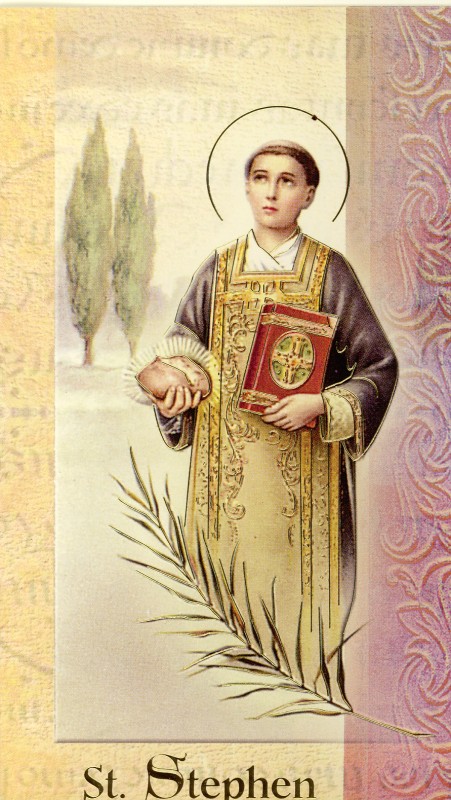
| SAINT STEPHEN—THE FIRST MARTYR—C. 35 |
Feast: December 26 |
All that we know of the life, trial, and death of St. Stephen, the first martyr, is found in the Book of Acts, chapters vi and vii. In the long chronicle of Christian martyrs, the story of Stephen stands out as one of the most moving and memorable. Although his name is Greek (from Stephanos, meaning crown), Stephen was a Jew, probably among those who had been born or who had lived beyond the borders of Palestine, and therefore had come under the influence of the prevailing Hellenistic culture. The New Testament does not give us the circumstances of his conversion. It would seem, however, that soon after the death of the Messiah he rose to a position of prominence among the Christians of Jerusalem and used his talents especially to win over the Greek-speaking residents of the city.The earliest mention of Stephen is when he is listed among the seven men chosen to supervise the public tables. We recall that these first Christians held their property in common, the well-to-do sharing what they possessed with the poor; and at this time, as always in the wake of war, there were many “displaced persons” in need of charity. We read in Acts that the Hellenists, as the Greek-speaking Christians were called, thought that they, particularly the widows among them, were being discriminated against at the public tables. The Apostles were informed of these complaints, but they were too busy to deal with the problem. Therefore seven good and prudent men were selected to administer and supervise the tables. The seven, on being presented to the Apostles, were prayed over and ordained by the imposition of hands. Associated in these charitable tasks with Stephen, whose name heads the list as “a man full of faith and the Holy Spirit,” were Philip, known as “the Evangelist,” Prochorus, Nicanor, Timon, Parmenas, and Nicholas-all Greek names. The title of deacon, which came to be linked with their function, derives from the Greek verb meaning “to minister.” These men served the Christian community in temporal and charitable affairs; later on they were to assume minor religious offices.Stephen, already a leader, now began to speak in public with more vigor and, “full of grace and power, was working great wonders and signs among the people.” By this time a number of Jewish priests had been converted to the new faith, but they still held to the old traditions and rules as laid down in Mosaic law. Stephen was prepared to engage in controversy with them, eager to point out that, according to the Master, the old law had been superseded. He was continually quoting Jesus and the prophets to the effect that external usages and all the ancient holy rites were of less importance than the spirit; that even the Temple might be destroyed, as it had been in the past, without damage to the true and eternal religion. It was talk of this sort, carried by hearsay and rumor about the city, and often misquoted, intentionally or not, that was to draw down upon Stephen the wrath of the Jewish priestly class.It was in a certain synagogue of Jews “called that of the Freedmen, and of the Cyrenians and of the Alexandrians and of those from Cilicia and the province of Asia” that Stephen chiefly disputed. Perhaps they did not understand him; at all events, they could not make effective answer, and so fell to abusing him. They bribed men to say that Stephen was speaking blasphemous words against Moses and against God. The elders and the scribes were stirred up and brought him before the Sanhedrin, the supreme Jewish tribunal, which had authority in both civil and religious matters. False witnesses made their accusations; Stephen defended himself ably, reviewing the long spiritual history of his people; finally his defense turned into a bitter accusation. He concluded thus:“Yet not in houses made by hands does the Most High dwell, even as the prophet says…. Stiff-necked and uncircumcized in heart and ear, you always oppose the Holy Spirit; as your father did, so do you also. Which of the prophets have not your fathers persecuted? And they killed those who foretold the coming of the Just One, of whom you have now been the betrayers and murderers, you who received the Law as an ordinance of angels and did not keep it.”Thus castigated, the Jews could contain their anger no longer. They rushed upon Stephen, drove him outside the city to the place appointed, and stoned him. At this time Jewish law permitted the death penalty by stoning for blasphemy. Stephen, full of “grace and fortitude” to the very end, met the great test without flinching, praying the Lord to receive his spirit and not to lay this sin against the people. So perished the first martyr, his dying breath spent in prayer for those who killed him. Among those present at the scene and approving of the penalty meted out to Stephen was a young Jew named Saul, the future Paul, Apostle to the Gentiles: his own conversion to Christianity was to take place within a few short months.In the fifth century the priest Lucian writes of the discovery of the relics of Stephen, which now, it is believed, repose in the church of St. Lawrence in Rome.Saint Stephen, The First Martyr. Scriptural Saint. Celebration of Feast Day is December 26. |
Permanent link to this article: https://luisapiccarreta.com/1226-feast-of-st-stephen-the-first-martyr/


