
Author's posts
Jul 11
7/11 THE FEAST OF ST. BENEDICT
July 11 is The Feast of Saint Benedict
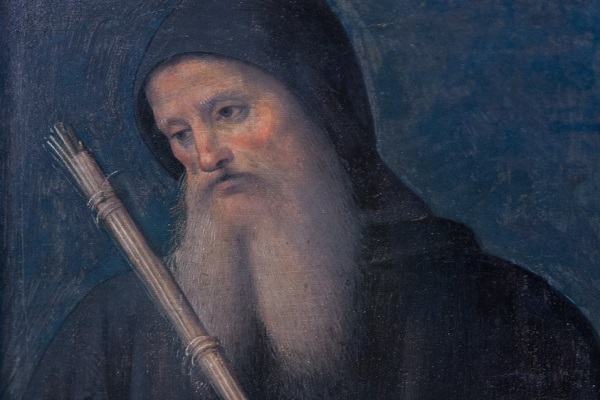
The feast of Saint Benedict will be celebrated by Catholics around the world on July 11.
St. Benedict is the patron saint of Europe as a whole, of students, sufferers of kidney disease and of poisoning. He lived from 480 AD up to 543AD. Though there is limited biography written about Benedict’s life, the saint is considered to be among the top contributors to the various Catholic traditions up to today. St. Benedict was canonized by Pope Honorius III in 1220.
Benedict came from an affluent family in Nurcia, Italy. He is also the twin brother of Scholastica who was also later on canonized as a saint. Together with a personal nurse or aid, Benedict was sent to Rome to study. Among the courses of interest back then was rhetoric or the art of persuasive speaking. But the young Benedict lost that interest to pursue his education when he saw how rhetoric was used in a negative way rather than to convey the truth. He also saw how students and life in the city in general focused on vices and pleasures instead of spirituality and the truth.
This made Benedict give up his wealth and inheritance and chose to live in a small village. But worldly pleasures still haunted him in the village so he decided to live a hermitic life at the Subiaco Mountains following directions of another hermit named Romanus. While living in a cave, the Devil tempted Benedict by posing as a lovely woman. But Benedict resisted by rolling his body into a thorn bush.
Upon learning his holiness, a group of monks asked for his guidance and leadership but they eventually tried to poison Benedict after experiencing his strict rules. It is said that the cup filled with poisoned drink shattered after Benedict prayed over it. Another set of monks followed Benedict. They were more obedient to Benedict, urging the saint to build monasteries for each of the twelve monks.
The Monte Cassino was considered the major monastery built by Benedict, where the tradition of monasticism has its roots. Benedict built the larger monastery to house monks, disciples, would-be priests and all other individuals pursuing a religious life. The saint preferred a whole community setup with a leader and set of rules instead of small and dispersed monasteries.
Another miracle attributed to St. Benedict is the story of how he made oil overflow in a jar after praying to God, after the monastery’s cellarer refused to give a little oil to a beggar because the jar is nearly empty.
Contributions of St. Benedict
St. Benedict initiated the ascetic and monastic system for the Catholic religion. That is, the need for church and spiritual leaders to renounce worldly pursuits, pleasures and materials things and devoting one’s self to purely religious and spiritual work. The saint founded the idea that would-be leaders of the church should live separately and as a community in monasteries following the directives of an abbot or head priest.
If you will ask any Catholic priest, he certainly knows the Rule of Saint Benedict. The Rule is a set of guidelines or wisdoms of Benedict that tackled how church leaders should run a monastery, the church in general and most importantly, it contained instructions on how to live a spiritual life.
The Middle Ages is also alternately called as the Benedictine centuries because the saint is the key influence to the advancement of European civilization at that time. St. Benedict was also the one who made instructions that church leaders should critically study, learn and imbibe the details and lessons of the Scriptures instead of simply memorizing and reciting them at masses.
The Liberating Power of the St. Benedict Medal
 Elizabeth Scalia | Apr 26, 2016
The Jubilee Medal of St. Benedict is recognized by the Catholic Church as a sacramental of great power, particularly for those seeking healing from illnesses and deliverance from demonic influences.
Like every sacramental, its power does not lie in its beauty, or even in the prayer engraved on it, but can only be ascribed to the merits of Christ Jesus, to the efficacious prayers of St. Benedict, to the blessing of the Church and to the faith and disposition of the person using the medal. They walk not in superstition but in faith, like the hemorrhagic woman who believed her healing could come from the mere touch of the tassel of Christ’s cloak, or like those who had been healed and exorcised through a cloth that had been in contact with St. Paul.
“When handkerchiefs or aprons that had merely touched his skin were placed on sick people, they were healed of their diseases, and evil spirits were expelled” (Acts 19:12).
The medal of St. Benedict is covered back and front with images, and also with a curious series of letters. On the front, the great Abbot and founder of Western Monasticism is depicted at the center. In his right hand he holds a cross, representing the saving power of Christ. In his left hand he shows the book of the Holy Rule, followed by his spiritual descendants even to modern times, and symbolizing here the Benedictine work of prayer and evangelization over the centuries.
The meaning of the series of letters displayed on both sides of the medal went unknown until, in 1647, a manuscript dating to 1415 was discovered in the Abbey of Metten in Bavaria. It explained that each letter represents one word of a Latin prayer of exorcism.
So, let us look at the medal:
At the center of the front of the medal is, of course, Benedict, in the robes of a monk. To his right is a broken cup, which recalls an incident in Benedict’s life: rebellious monks, angry with Benedict, had poisoned his wine. When, at the start of his meal, he made the sign of the cross the cup shattered, and the conspirators fled.
To Benedict’s left is a raven, which removed bread that had also been poisoned.
Above the cup and the raven are the words Crux Sancti Patris, Benedicti (The Cross of our Holy Father, Benedict). Around the edge, enclosing the image of Benedict are the words Eius in obitu nostro praesentia muniamur! (“May we be strengthened by his presence in the hour of our death!”)
St. Benedict is — like St. Joseph — a patron of a “happy death.”
Under his feet there are the letters ex SM Casino MDCCCLXX (From holy Mounte Cassino, 1880). This commemorates the striking of this medal on the 1400th anniversary of Benedict’s birth. St. Scholastica was his twin.
The back of the medal is dominated by central cross. At the top of the cross is the word “pax,” Latin for “peace.” This is the greeting and motto of the Benedictine Order.
All around the cross, from each side, are four large letters: C. S. P. B. (Crux Sancti Patris Benedicti, or “Cross of the Holy Father Benedict”).
In the vertical line of the cross are again initial letters of a Latin prayer, “Crux sacra sit mihi lux! Nunquam draco sit mihi dux!” As follows:
- C. S. S. M. L. (Crux Sacra Sit Mihi Lux): “The Holy Cross be my light”
In the horizontal line of the cross:
- N. D. S. M. D. (Non Draco Sit Mihi Dux) “May the dragon never be my guide!)
Starting from the top, in a clockwise direction, and around the edge appear the initials of the prayer of exorcism:
- V. R. S. (Vade Retro Satan): “Get away, Satan”
- N. S. M. V. (Not Suade Mihi Vana): “Never tempt me with your vanities!”
- S. M. Q. L. (Sunt Mala Quae Libas): “What you offer me is evil.”
- I. V. B. (Ipse Venena Bibas): “Drink the poison yourself!”
The medal itself does not have power, and to believe so would be an un-Christian act of superstition. Rather, the medal is a visible sign of the inner devotion and faith of the believer in Jesus Christ and in his servant, St. Benedict, who acts by faith.
As the medal is a prayer of exorcism against Satan, it is used to call down God’s blessing and protection upon us, through the intercession of the great saint. It is also a reminder of our baptismal rejection of all that is evil.
There is a plenary indulgence granted to anyone who, at the hour of death, “uses, kisses or hold the blessed medal between the hands with veneration.” The indulgence is also granted if the person entrusts his soul to God, makes a good confession and receive Holy Communion.
Through an order of the Sacred Congregation of Religious in 1965, Benedictine Oblates (lay Benedictines) are permitted to wear the medal of St. Benedict in place of the small black cloth scapular that had formerly been worn.
Permanent link to this article: https://luisapiccarreta.com/7-11-the-feast-of-st-benedict/
Jun 26
6/27 – FEAST OF OUR LADY OF PERPETUAL HELP
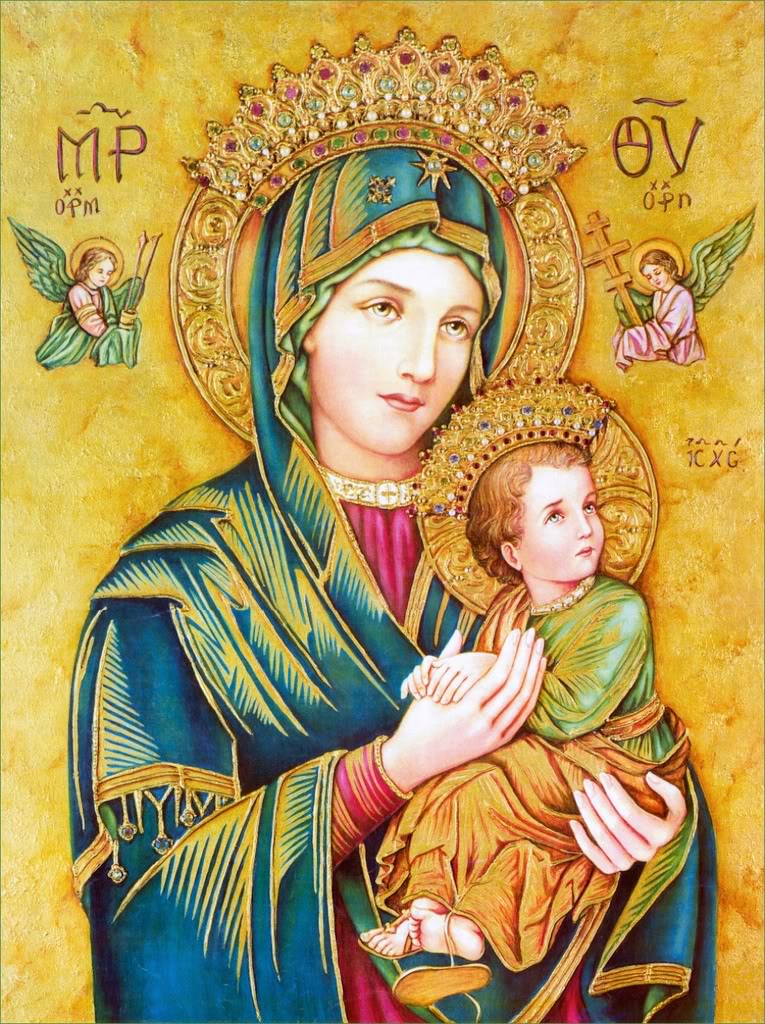
The image of Our Lady of Perpetual Help is an icon, painted on wood, and seems to have originated around the thirteenth century. Traditionally, the image is also known as “Our Lady of Perpetual Succour.” The icon (about 54 x 41.5 centimeters) depicts our Blessed Mother Mary, under the title “Mother of God,” holding the Child Jesus. The Archangels Michael and Gabriel, hovering in the upper corners, hold the instruments of the Passion– St. Michael (in the left corner) holds the spear, the wine-soaked sponge, and the crown of thorns, and St. Gabriel (in the right corner) holds the cross and the nails. The intent of the artist was to portray the Child Jesus contemplating the vision of His future Passion. The anguish He feels is shown by the loss of one of His sandals. Nevertheless, the icon also conveys the triumph of Christ over sin and death, symbolized by the golden background (a sign of the glory of the resurrection) and the manner in which the angels hold the instruments, i.e. like trophies gathered up from Calvary on Easter morning.
In a very beautiful way, the Child Jesus grasps the hand of the Blessed Mother. He seeks comfort from His mother, as He sees the instruments of His passion. The position of Mary’s hands– both holding the Child Jesus (who seems like a small adult) and presenting Him to us– convey the reality of our Lord’s incarnation, that He is true God who became also true man. In iconography, Mary here is represented as the Hodighitria, the one who guides us to the Redeemer. She also is our Help, who intercedes on our behalf with her Son. The star painted on Mary’s veil, centered on her forehead, highlights her role in the plan of salvation as both the Mother of God and our Mother
According to popular tradition, a merchant acquired the icon of Our Lady of Perpetual Help from the island of Crete and had it shipped to Rome towards the end of the fifteenth century. During the voyage, a terrible storm arose, threatening the lives of all on ship. The passengers and crew prayed to our Blessed Mother, and were saved.
Once in Rome, the merchant, dying, ordered that the image should be displayed for public veneration. His friend, who retained the image, received further instructions: in a dream to his little daughter, the Blessed Mother appeared and expressed the desire for the image to be venerated in a Church between the Basilicas of St. Mary Major and St. John Lateran in Rome. The image, consequently, was housed at the Church of St. Matthew, and became known as “The Madonna of Saint Matthew.” Pilgrims flocked to the church for the next three hundred years, and great graces were bestowed upon the faithful.
After Napoleon’s troops destroyed the Church of St. Matthew in 1812, the image was transferred to the Church of St. Mary in Posterula, and remained there for nearly forty years. There, the image was neglected and forgotten.
By divine providence, the forgotten image was rediscovered. In 1866, Blessed Pope Pius IX entrusted the image to the Redemptorists, who had just built the Church of St. Alphonsus, down the street from St. Mary Major. As a boy, the Holy Father had prayed before the image in the Church of St. Matthew. He ordered the public display and veneration of the image, and fixed the feast of Our Lady of Perpetual Help as the Sunday before the Feast of the Nativity of St. John the Baptist. In 1867, when the image was being carried in a solemn procession through the streets, a young child was cured, the first of many recorded miracles attributed to Our Lady of Perpetual Help.
To this day, the Church of St. Alphonsus displays the icon of Our Lady of Perpetual Help and welcome pilgrims for prayer. May each of us never hesitate to invoke the prayers and intercession of Our Blessed Mother in time of need.
Permanent link to this article: https://luisapiccarreta.com/6-27-feast-of-our-lady-of-perpetual-help/
Jun 24
6/25 The Secret Weapon We Need to Utilize!
The Secret Weapon We Need to Utilize!
Click here for Website
“And he said to them, because of the littleness of your faith; for truly I say to you, if you have faith the size of a mustard seed, you will say to this mountain, move from here to there, and it will move and nothing will be impossible to you. But this kind does not go out except by prayer and fasting” (Matt. 17:20-21).
There are hundreds of verses in the Old and New Testament that speak of fasting. Many of those verses are around epic stories of how Israel won battles where the circumstances were not in their favor. The Lord was clearly showing that through fasting, the destiny of a nation can change. In the verse directly above, the words “nothing will be impossible to you” is used. If you were to dwell on that phrase alone, it is a mighty big promise from the Lord Himself.
So the question must be asked, why do we not fast more often? I think there are many answers to that question, but one conclusion is that we lack the discipline. Laziness, lack of belief, a busy schedule, headaches, fatigue, sloth, unwillingness to deny a simple pleasure to our body, not fervent enough to conquer a personal prayer request, not wanting something bad enough, seeing too big an obstacle….are just a few reasons why we don’t fast. But, when the history of the entire bible is viewed through the pages of scripture, fasting is a key spiritual weapon for the salvation of nations and souls.
Saint Alphonsus de Liguori said, “God has given us the goods of the earth, not only that we may enjoy them, but also that we may have the means of …showing Him our love by voluntary renunciation of His gifts, and by the oblation of them to His glory. To abandon, for God’s sake, all worldly enjoyments, has always been the practice of holy souls.”
Through fasting we renounce the body, and simultaneously we heighten our spiritual senses. We also become more cognizant of our speech and actions. Throughout all of biblical history, fasting has been a staple of an individual or a nation that wants to turn the tide of current events. It is the biblical and historical greats that have made it a part of their spiritual regimen to fast. Today, it is a highly neglected spiritual practice among even the most faithful. If you were to google fasting, hundreds of examples pop up, and those verses are a very small part of the whole story being told.
Fasting is a part of the biblical narrative from start to finish. Just before Jesus began His earthly ministry, He went into the desert to fast and prepare Him for His public ministry. Think of how profound it was, that God Himself would do this. “Then Jesus was led by the Spirit out into the wilderness to be tempted by the devil. He fasted for forty days and forty nights after which he was very hungry, and the tempter came to Him (Matt. 4:1-2). When one does fast, it shows they are in serious prayer for an intention.
While the young Hebrew nation was slowly marching towards the land of milk and honey, “Yahweh said, Moses, put these words in writing, for they are the terms of the covenant I am making with you and Israel. He stayed there with Yahweh for forty days and forty nights, eating and drinking nothing. He inscribed on the tablets the words of the Covenant —the Ten Commandments.” (Exodus 34:27-28).
Above are two of the most significant events in world history. Yahweh is prescribing for His people while wandering in the desert a new covenant, a new way of living for His people that will last thousands of years, — and for some people until this very day. Then, when the Lord gives us a New Covenant that came through His Son Jesus, fasting is the fundamental action needed to get the purity of the event transcribed to the people. Moses and Jesus each fasted for forty days. This defies all rational and modern era reasoning that fasting could alter the destiny of all mankind. If we talked less, and fasted more, we would see more answers to our prayers. Through our actions we would be saying to the Lord, you take over, it is bigger than me. My faith is in You Jesus to cast this mountain into the sea.
Queen Esther knew that her people were in trouble and could be destroyed through an evil authority figure of the King of Persia. Knowing the threat was very real, she became very dtermined and said, “Go, gather all the Jews, to be found in Susa, and hold a fast on my behalf, and do not eat or drink for three days, night or day. I, and my young women will also fast as you do. Then I will go to the king, though it is against the law, and if I perish, I perish” (Esther 4:16). The Lord heard their cry, and the Jewish people were spared.
Fasting has spiritual and physical components that can prevent us from evil or impure thoughts. Fasting is a method to acquire purity of heart because it gives us the needed grace for prayer. St. John Chrysostom said, “Prayer and fasting are like two wings that carry a person to the heights of God.” Fasting is also a sign of expectation. We are in active supplication and petition asking in faith and in expectation for an answer due to our action because we are trusting God for the outcome. Fasting is an outward sign that we are serious to have a prayer answered. Fasting is for protection. Fasting helps us to become free from what prevents our growth because we are often stagnant and not growing spiritually.
There are numerous scriptures that indicate fasting is a sign of repentance. Fasting is a sign of humility. We have in essence thrown up our hands saying, I am at my wits end, and it is time for Your glory to be manifested as this event is too big for me to do, and You alone can change it. We face many of these difficulties in our lives on a daily basis, yet we fail to fast or pray hoping we can change on our own merit alone. First and foremost, fasting requires a discipline and reorienting priorities.
For those who are unable to fast for physical reasons, there are other ways of mortification or immolation. The Lord is not a bureaucrat requiring ritualistic formula’s constricting the work of the Holy Spirit. He alone knows our heart when we fast for the correct reasons. He alone is judge. Ascetical reasons alone are not good enough, as many people use fasting as a form of dieting. You will know if you are on the right path if you are exhibiting kindness and mercy. It will curb the sin of Adam and as Saint Peter Chrysologus wrote, “Fasting is the soul of prayer, mercy is the lifeblood of fasting. So if you pray, fast; if you fast, show mercy; if you want your petition to be heard, hear the petition of others. If you do not close your ear to others, you open God’s ear to yourself” (Sermo 43: PL 52, 320, 322).
Fasting has been one of the most consistent messages at Medjugorje since Our Lady started appearing there in 1981. Below has been compiled by a Friend of Medjugorje and are just a few of the many that could be listed, but they show how important fasting is in the eyes of heaven.
1. Fasting stops wars. 7/21/82
2. Fasting can suspend the laws of nature. 7/21/82
3. Fasting reduces punishments from God. 11/16/82
4. Fasting is a weapon of significant power to defeat satan which atomic power does not compare. Atomic power has no strength to conquer satan. 6/25/92
5. Bread and water is the best fast. 7/21/82
6. Fasting to be powerful must be done with the heart. 9/20/84
7. Through fasting the whole plan of Our Lady, that God Himself planned for the world’s salvation during this special time, will be achieved. 9/26/85
8. By giving our fasting to Our Lady, satan is unable to seduce us and it drives him away. 9/4/85
9. Fasting purifies our hearts from the sins of the past. 12/4/86
10. Fasting, coupled with prayer will obtain everything you ask for (the exception is something illicit). 10/29/83
11. Fasting sanctifies you to the Holy Spirit. 11/4/83
12.Humility is a fruit from fasting when coupled with prayer. 2/10/84
13.The present fasting in the Church is not adequate. Our Lady desires this to change. She said fasting has been forgotten in the last quarter of this century in the Catholic Church. 5/84.
14.Fasting is one element that keeps satan from conquering us. Faith and prayer are the other two. 6/25/92
15. Satan is enraged against those who fast and convert. 6/16/83
16.Fasting for the sick can cure them with faith and prayer. 11/26/81
17. Fasting and prayer can stop arguments in the Holy Priesthood. 1/21/82
18.Fasting will bring the Kingdom of God among us. 3/14/84
19.Fasting makes Our Lady happy. 8/5/84
20. Fasting will make prayer more vigorous. 1/25/84
21.Our Lady will make the maximum good come from our fast. She wants us to give our fast to her, which she disposes of them “according to the will of God.” 9/24/82
22. Fasting, coupled with prayer, especially community prayer will protect you from satan’s aggression in destroying marriages, creating division among priests, and will crush satan in his plans for obsessions and murders in society. 12/26/82
23. We are to fast out of gratitude. 9/20/84
24. It is best you let no one know you are fasting. 1/28/87
25. Fast to prepare for the coming of Jesus. 11/25/96
Fasting has been a constant message throughout history at the authentic apparitions sites of Our Lady. She is a powerful prophetess for love and mercy to the world through her messages, and prayer and fasting are always central. Saint John Paul II in his 1994 encyclical Evangelium Vitae said, “Jesus Himself has shown us by His own example that prayer and fasting are the first and foremost effective weapons against the forces of evil.”
The single greatest discourse of length where Jesus gave instructions on spiritual conduct for the believer in the world was the Sermon on the Mount. His instructions on fasting were, “When you fast do not put on a gloomy look as the hypocrites do; they pull long faces to let men know they are fasting. I tell you solemnly, they have had their reward. But when you fast, put oil on your head and wash your face. So that no one will know you are fasting except your Father who sees all that is done in secret; and your Father who sees all that is done in secret will reward you” (Matt. 6: 16-18).
Jesus, I Trust In You!
Permanent link to this article: https://luisapiccarreta.com/6-25-the-secret-weapon-we-need-to-utilize/
Jun 23
6/24 FEAST OF THE NATIVITY OF ST. JOHN THE BAPTIST
6/24 Feast of the Nativity of St. John the Baptist

Today we celebrate the birthday of St. John the Baptist – one of three birthdays in the Catholic liturgical calendar, the others being that of the Lord Jesus Christ Himself and of His Blessed Mother. It is interesting to note that St. John the Baptist’s birthday comes just as the days are starting to get shorter (in the Northern Hemisphere), whereas Christ’s birthday comes just as they are starting to get longer: “He must increase, I must decrease” (John 3:30).
Book of Heaven
6/24/00 – Vol. 3
After this, giving a little respite to His moans, He (Our Lord Jesus Christ) told me (Servant of God Luisa Piccarreta): “My daughter, it is these sad times that force Me to this (chastise), because men have grown so bold and proud, that everyone thinks he is the god of himself; and if I do not lay hand to scourges, I would do harm to their souls, because the cross alone is the nourishment of humility. So, if I did not do it, I Myself would cause them to lack the means to be humiliated and to surrender from their strange madness, even though the majority of them offends Me more. But I do this like a father who breaks the bread for all to be nourished – a bread which some of his children do not want to take; even more, they use it to throw it in their father’s face. What has the poor father done wrong? So I am. Therefore, compassionate Me in my afflictions.”
Having said this, He disappeared, leaving me half-awake and half-asleep, not knowing, myself, whether I have to wake up completely, or go back to sleep.
6/24 It was officially announced that the two Theological Censors appointed by the Holy See to review the Writings of the Servant of God Luisa Piccarreata had given their approval.
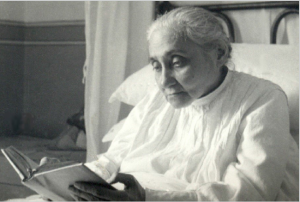
The Little Daughter of the Divine Will, Luisa Piccarreta
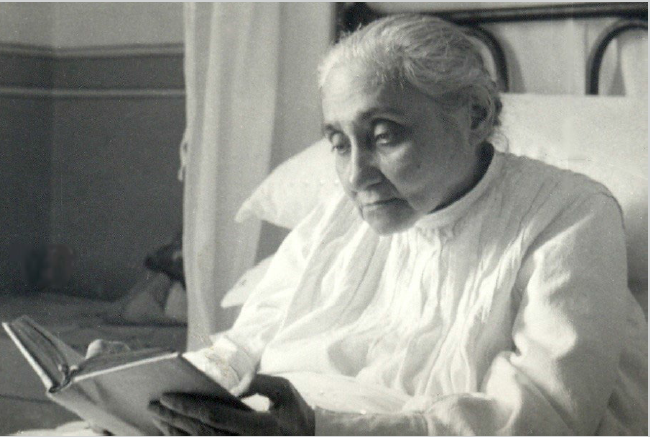
On July 23, 2010 Sister Assunta Marigliano, President of the Pious Association announced unoficially ‘great news which brings great joy’:
“We are glad to inform you that the second Theologian, which the Holy See had appointed to review the Writings of the Servant of God Luisa Piccarreta, has completed his task and given his approval.”
On July 24, 2010 it was officially announced that the two Theological Censors appointed by the Holy See to review the Writings of the Servant of God Luisa Piccarreta had given their approval.
Permanent link to this article: https://luisapiccarreta.com/6-24-feast-of-the-nativity-of-st-john-the-baptist/
Jun 22
OUR LADY OF AMERICA SONG
OUR LADY OF AMERICA SONG
 Link to Our Lady of America Song
The words to the song “Our Lady of America” were written by Sister Mildred Mary Ephrem Neuzil herself under a moment of inspiration.
Permanent link to this article: https://luisapiccarreta.com/our-lady-of-america-song/